To Megalo Mas Spiti (Our Big Home): two weeks after reopening, to be continued…

We felt motivated to be back in Our Big Home after four months of lockdown, although we only had two weeks together before the summer closure. The team was eagerly awaiting this time to arrive, but it certainly took some time for the warmth and friendly atmosphere to find its place again. It took time for the Welcomers to welcome again in the same way, for the parents to feel the familiarity of the place and at ease, and for the children to interact with each other. There was a deep concern about feeling secure regarding Covid-19 on top of everything else that could not be disregarded. The residue of the circumstances of the pandemic that we are experiencing were, and still are, very present.

Overall we had very few visitors over those two weeks. However, the high temperature of the summer period in Greece may also play a part in the limited visitors, or for their arrival at 7pm (one hour before closing time). According to our new measures we were only able to welcome up to five children at a time, therefore there was, somehow, a sense that the children were being watched by the adults, and we suspected that the ratio of children to Welcomers may have influenced the atmosphere of the place. One initial thought was that by limiting the number of families, and having some restrictions on socialization and ways of interacting in general, effected the social aspect of our work. The visitors arrived hesitantly at the beginning, but as soon as they started to communicate, to realize the stability of the place, and to remember the toys, they seemed more relaxed. The small children were trying to reconnect – with the place, the Welcomers, between themselves, as well as with the elderly visitors. Some parents wanted to share their concerns with the Welcomers, while at the same time the children were trying to interact with them. There was a need for parents to talk about the lockdown, their difficulties, and the changes that have emerged. At the same time they expressed their happiness about our reopening. One mother told us how she often checked social media for our announcements to see when we would open, and it seemed as if Our Big Home had a protective role for her.

From our side, we were content to see how the children had grown – for example, some of them used to crawl and now they were walking around and exploring the place by themselves. Others came to say goodbye as they turned four years old. This by itself shows the importance of the closure for both the children and the parents, and the impact that this place can have on the family and the child’s development. Furthermore, a number of families visited us for the first time during this reopening period, which may bode well for September onwards.

Until now, we used to reopen in the first week of September, normally after the summer holidays. As it is now highly recommended to stay in quarantine for a week after returning from a holiday abroad, we decided to have our first team meeting on the first Sunday of the month, and to open Our Big Home the week after. However, there is an uncertainty around the circumstances of the pandemic and whether we will need to reconsider our measures once again.

We keep our desire for Our Big Home despite the difficulties, as we make the effort to reconnect and readjust to a new reality.

To be continued…

Written by the team at To Megalo Mas Spiti
La fête (part one): risky play and the Carnivalesque

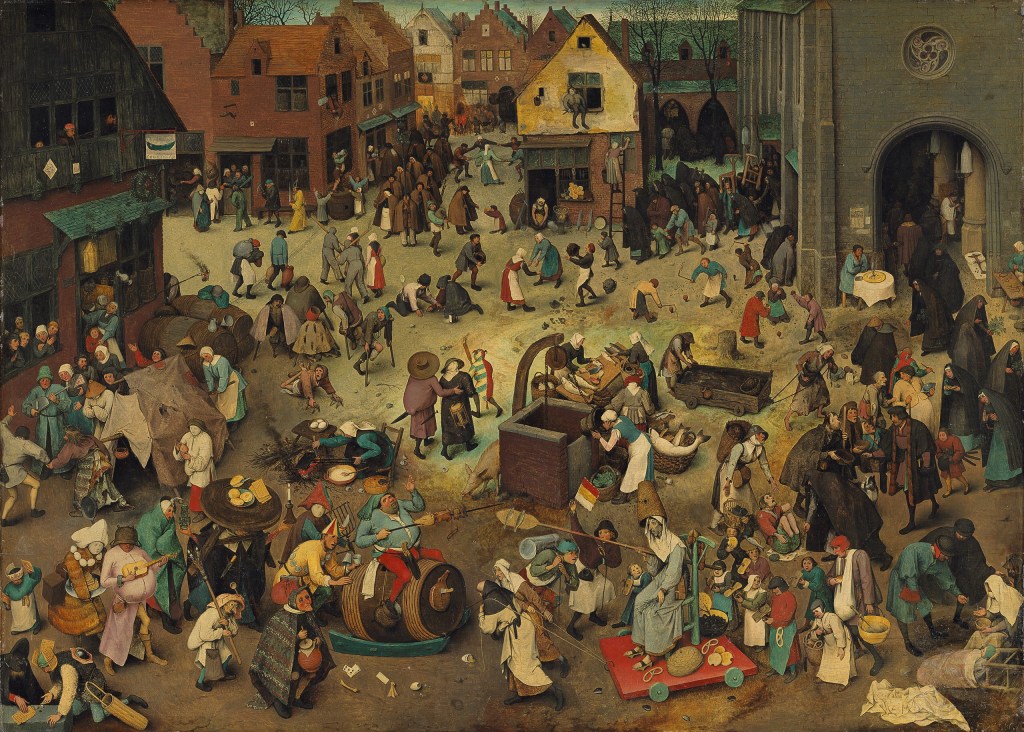
The Fight between the Carnival and Lent (1559) by Peter Bruegel the Elder

At a new reading group in London we have been lucky enough to receive some informal translations of Dolto’s work by Sally Bird. We began by slowly reading through her very thoughtful translation of an interview with Dolto in 1978 where Dolto describes something – a concept or a notion, perhaps – which she names la fête.

La fête seems to be something akin to a momentary state of being which involves joy, surprise, a being with others, but also risk. It has both a simplicity and a complexity to it and gave rise to many thoughts about our work with young children in the community both theoretically, and practically in thinking about how we design our spaces.

A first question that arose was the translator’s decision not to translate la fête but to leave it in the original French. Our French colleagues spoke about the very specific connotations of la fête in French – a term, it is worth mentioning, that does not have the same meaning as the village fête in England. In French la fête connotes joy and community, to revel, and to feast with others. And, in Dolto’s la fête there is an enjoyment which only appears through the experience of risk. Dolto describes play itself as “the enjoying of a desire that is carried through to a successful conclusion by way of some risk”. The element of risk in what Dolto describes could not be found in the translations that the group put forward for la fête including how we understand the word ‘fête’ in the English language, and it is this aspect of what she describes, the element of risk, which particularly caught my attention.

Risk

Dolto describes “the risk of freedom”; something which takes place in a liminal space between safety and danger. Thinking of the British context, her opening remark in the interview, “La fête is freedom within security”, echoes that of A.S. Neill’s mantra ‘freedom not license’. It points us towards the idea that joy, or enjoyment needs an element of risk without danger; that risk does not mean ‘anything goes’ (as Neill was often accused of) but that ‘anything goes’ within a framework. Summerhill – the ‘school with no rules’ as the British press liked to call it – has a very fundamental framework of democratic meetings. Similarly, The Maison Verte has a framework: there is a red line (introducing the idea of a limit rather than a border) and the children wear an apron when playing with water. Within this social framework there is no normative which might be found in other settings where things like ‘developmental milestones’ are monitored and regularly assessed. At the Maison Verte there is the risk of subjectivity on offer.

Practically speaking, the discourse of ‘risky play’ which is being developed in the UK also has a very useful mantra: they talk about facilitating ‘risk not hazards’. In one demonstration for example, a play worker pulls out nails from some pieces of wood for his adventure playground. These are a hazard, he says. The fire pit in the middle of the playground, that’s a risk.

The Carnivalesque

The idea of the carnivalesque came up as a possible translation for la fête which includes risk. Although, perhaps, too rowdy and infused with profanity, Mikhail Bakhtin’s ideas of the grotesque and revolution could represent what we do at the Maison Verte, and I was intrigued by this suggestion. In fact, in a more subtle way I think we do see the Maison Verte as having a revolutionary potential. The Maison Verte makes space for the experience of both community and risk, alongside each other, and it makes space for that to be a possibility for our very youngest members of society. Dolto advocates for children to have spaces where they can meet others but also take risks and Dolto described the work as ‘psychoanalysis on the street’. She saw the Maison Verte as the people’s agora which sits outside of the council driven, risk averse, bureaucratic institutions of the nursery and the crèche.

The grotesque aspect of the carnivalesque also resonates. Bakhtin describes the grotesque as a literary trope which expresses “biological and social exchange”. There is an emphasis on the holes of the body – the mouth, the anus – as that through which the outside world enters and leaves: through eating, shitting, singing, burping etc. When reminding myself of Bakhtin’s theory which I read more than 10 years ago, before any engagement with psychoanalysis, I was immediately reminded of the drive and its objects which circulate; the anal, oral, voice and gaze. While at the heart of any psychoanalysis the drive is of particular importance for young children and their parents as they learn to speak, eat solid foods, become ‘potty trained’ and become subjects with a relationship to both the body and the social bond.

Lastly, the carnivalesque, in Bakhtin’s analysis, is constructed through polyphonic dialogue which he describes as creating a ‘dialogic sense of truth’. It involves a decentralisation of the authorial voice in favour of simultaneous points of view. Applying this to our work, I am of course reminded of the Welcomers’ role and the structure which sees a rotation of those who intervene. Welcomers speak neither from the position of the expert nor from the position of the ‘institution’. At a Maison Verte one experiences a polyphony of voices including the Welcomers, other parents and, of course, the children themselves.

While I don’t mean to make a direct comparison between the carnivalesque and Dolto’s concept of la fête, I do think that this sometimes ungraspable phenomenon we call play is a revolutionary work when we give it space. In this interview Dolto describes play as “the enjoying of a desire that is carried through to a successful conclusion by way of some risk” and I am reminded of the video below.

Written by Catherine from The Green House Playgroup

To Megalo Mas Spiti (Our Big Home) Reopens…

In Greece, like in most countries worldwide we had a wide lockdown because of the pandemic of Covid-19. Schools, nurseries, playgrounds as well as “Our Big Home” had to close down from the beginning of March due to safety measures.

Initially, the team decided to stop ‘welcoming’ our visitors for two weeks, even though there was no clear protocol, until we had some more information about the situation and how it would develop. As in most places, it lasted longer than we expected. However, during this unprecedented threatening period the team was having web meetings every fortnight, sharing concerns and ideas about ways of keeping a part of our project alive, even without our physical presence. How could we be present and available from a distance and how could we be more adaptable and flexible, while preserving our rules and values at the same time, where is the limit between practitioners’ and parents’ responsibility for children’s safety? These were some of the core points that the team was reflecting on.

Our presence on social media (on Facebook and our website: http://www.tomegalomasspiti.gr which can be translated into English by accessing it through Google) was regular either with an article for our project, a comic note about Corona virus addressed to the children, or an audio interview of a paediatrician providing advice on safety measures and discussing opinions. After much thought and a lot of discussion “Our Big Home” team decided that they could be available as Welcomers through a phone line, and willing to listen to parents’ concerns within this period of the pandemic, discussing how they and their children cope or any resulting aspect they wanted to share. There was one phone call during this time. It was a very useful conversation from which emerged the mother’s realisation that she hadn’t talked to her daughter about Corona virus at all during this time.

In our opinion, the fact that during the quarantine we did not have many calls, may be due to the fragility of structures like Our Big Home: the absence of calls shows that parents and children are attached to the specific framework of welcoming, through a lively and real contact with the Welcomers. It seems that there was a difficulty in switching to a distant form of communication. Were they waiting for the place to function again? We assume that this is the case. Moreover, some parents who we bumped into mentioned that they were looking forward to our reopening.

The whole team met again in person mid-June, when we decided that “Our Big Home” will reopen for two weeks beginning 1st of July. The reopening aimed to reposition ourselves in our role as Welcomers, to be in touch with our visitors again, and to have a proper closure before the summer holidays. We also wanted to have a trial of the special conditions of our work that we may most probably have to follow in September. Some new adjustable measures/rules that we had to apply, are as follows: up to 5 children each time inside the Home and only one adult to accompany them, fewer toys and markers available, no rag dolls nor carpets, keeping the windows open, antibacterial wipes available, masks if necessary, disinfection of plastic toys after every shift and regular cleaning.

Still, we are having very few visitors since the reopening, and this could indicate that the safety measures, although they protect public health in Greece, had a negative impact on families feeling secure and trusting public structures of early prevention and socialisation. We formulate the hypothesis that this extraordinary situation of threat upon health and life enhanced the traditional tendency to view family as the only safe framework of development for very young children. We can only hope that this is a temporary incidence of a collective traumatic situation, which is now manifesting its influence on social bonds and desire to meet people outside home.

We expect that this two week experience will give us a good picture of the way that the post-pandemic reopening can be feasible and empower “Our Big Home” again to keep its desire and purpose alive.

On behalf of our team, we are happy to keep sharing this insight and also hear from other ‘Homes’ of the world, regarding common or different pathways we may follow, all based on a very important endeavour inspired from F. Dolto.

Written by the team at To Megalo Mas Spiti