By Nikos Pavlatos
Translation: Christina Iosifidou, Maria Kakogianni, Andreana Maragou and Nikos Pavlatos.

We live in a period of prolonged social distancing, that is, under a legal prohibition of social contacts which concerns almost all aspects of social life: work, education, entertainment, sports and even health since telemedicine is now a reality. Every contact with another is the potential danger for transmission of an uncontrolled and terrifying infection, for which each one of us, according to the official discourse, is held responsible for on an individual basis.
We have withdrawn into our close social circles, avoiding any interaction that was previously taken for granted, and which, in the case that it was missing, is to be replaced as soon as possible. The individual’s fulfilment through work, education and exercise, and also the preservation of health was (and still is) an ideal, of which good socialisation is an essential prerequisite.
And suddenly… this situation of emergency is extended for months, and each person has to consider himself as a potential carrier of infection for the other: according to the medical and political authorities in Greece this is the attitude we must adopt on an individual and a collective level in order to tame a pandemic that undermines health and life. The sociomedical ideal imposes a drastic restriction of sociability and comes into contrast with the modern hypertrophic representation of the autonomous and self-ruled individual. Through images of the seriously ill and intubated patients in isolation, our representation of the human being returns to the state of absolute loneliness and helplessness where no invocation to the other can be heard. Everything is filtered through the need to limit the transmission of this unknown evil that paralyses thought and freezes emotion. Bonds of solidarity and concern for others are at risk of being crushed by fear.
Yet, what is sociability? How is this bond with the other created that allows for this highly desired fulfilment of personality? Primary sociability is the discovery of the other by the neonate who is one with the other: there is no distinction between himself and the mother. The mother, by caring for and protecting the baby, makes it possible for the baby to gradually recognise her as a separate person. She presents him with reality, piece by piece, by respecting, with her intuition, the developing skills of the child to accept the world as something outside of him. She, who has the knowledge and is the source of a future curiosity for knowledge, teaches the child to perceive and use the world in a beneficial and suitable way. The mother is the first significant other and the source of satisfactions and pleasures, and it is her who the child learns to ask for and expect since his perceptions and experiences depend on the other.
There follows a second phase of sociability when the infant, who has now become a child, is in a position to move away from the mother or significant others (the grandmother who looks after him when the mother is at work, his aunt or nanny, for example). After making their first steps at home and in the park, after the first experiences of moving outside of the home, there comes the time to go to nursery. In our present times, in many countries (as in Greece), compulsory school education keeps expanding towards the younger years of childhood, and a child who cannot adjust to the school environment is considered as liable to present developmental difficulties much earlier than in the past. Prevention becomes almost an imperative, and there tends to be no tolerance towards a slower pace of growing up.
What is this second phase of sociability that official institutions internationally value and, nowadays, monitor by waving their finger at parents (and children) if norms are violated? In terms of normality, it is the stage of taking steps away from the family, that is, moving away from the mother’s lap: in fact the father’s intervention, the discovery of his importance, has already prepared the ground for this first experience of distancing in the child’s relationship with the mother.
In psychoanalysis we talk about the paternal function. It is something that may sound quite emphatic. It simply means that the father or someone else that the mother refers to as a symbolic third, interferes to highlight to the child that it is time to stop thinking that he is everything for the mother. It is the fact that his mother does not belong to him as he thought she did. If we want to simplify things so as to make them clearer, the role of the father is to allow the child to meet with the truth that he is not the exclusive object of his mother’s love and that things other than himself also matter in her life.
How can a child and mother accept this separation that deprives them from each other? It is often very hard to go through this. But, it is a process that every child and every family need to go through in order for the child to have the joy of conquests: first by becoming more autonomous and later by acquiring a knowledge that leads him away from his early dependence on the parents. The father who separates the child from the mother is there to symbolically represent a law of personal development within society, introducing socialisation as an act of discovering a world outside of the maternal universe and the maternal care. The child who is no longer the centre of the world, needs to find other things outside of his home. The family is the first small society with its rules and restrictions: it is what the parents present to the child before introducing him, little by little, to the other, the big one/the big Other, as a social being. It has always been like this, this personal journey from one’s own close circle of safety to the unknown, yet thrilling, realm of social reality.
And all of a sudden things happen in such a way that this hard conquest must be suspended and everyone has to stay at home. A deadly threat has invaded life and everyone is talking about it. Some people work from home tied to their laptops and cellphones like never before, some do not have a job, some are on furlough and must go through the procedures to receive a survival allowance. The authorities implemented strict lockdowns for several months. Everyday points of reference are overthrown. Plans and desires are put on hold. Independence has become dependence within a climate of fear, responsibility is shifted from the aspiration of individual fulfilment to the preservation of life that has been shrunk to its biological dimension.
It is not only the child who gives up a lot in order to go to school. How many things did they have to do, this man who became a father and this woman who became a mother, to grow out of adolescence: the often prolonged dependence of youth has resulted in the setting up of their own family based on their childhood experiences. These are the experiences of satisfaction and dissatisfaction that form their inner richness but also carry forgotten impasses that each one managed to overcome: impasses that leave their traces in the shadows of new encounters and achievements.
The stay at home order brings setbacks to what parents and their children have achieved by leaving behind the pleasures of early childhood: that joy of sleeping or waking up with my child next to me in the cradle and that tender excitement about the new things he did today. During the lockdown these everyday pleasures and rewards of the early years, which form the basis of both the forgotten and active memories of family life (which operate as a continuum), become once again a mandatory point of reference. In Greece and in many other countries, we are urged or compelled to stay at home, that is, among other things, to stay together and away from others to protect ourselves and others. If parents can’t assign anything to others (teachers, friends or relatives) they become the only ones to refer to all over again. Meanwhile, uncertainty and the unknown go far beyond the parent’s ability to find solutions and answers to the questions that their children ask them even if they don’t dare to put them into words.
However, everything has its own time. In addition to protection, what also emerges in this confinement is anxiety, tension, nerves about the space that narrows materially and mentally and uncertainty about the future. The atmosphere of the house as a protective space is an extension of the first care given by the mother that sets the tone early on: this used to be the prerequisite for the thrill and the joy of discovering reality and otherness. How can one go back to this as if he could return to the cocoon and look upon things in an optimistic and embellished way, coloured by positive thinking? One is asked to remain inside and refrain from any gesture of spontaneity while under the moral obligation to act as if this is compatible with normality. This is then related to a sense of responsibility yet everything seems out of control.
All the things that were necessary and appropriate during the state of dependency return as the family closes in on itself again. Meanwhile, the actual need is for everyone to have their own space outside the family: school, work, grandparents, friendships, other families, a basketball team, the music school or the gym. How can one maintain the desire for another thing (Lacan) and not feel that one is suffocating from stagnation and repetition?
It is no wonder that in this condition what comes back, or appears through another form, are feelings that in the past may have accompanied the search for pleasure and were obstacles to maturation: fear, sadness, frustration or separation anxiety. In other words the difficulty of separation is the other side of an unachievable desire to separate. Some children don’t want to go to school while it is still open and want to stay with their mother as what they hear makes them feel it is dangerous to be in a different space from her. It is not the school that scares them, despite the masks and the rest of the protective measures.
The children don’t want to be away from their mother. Lockdown amounts to the suppression of the obligation to go to school. Children no longer have to leave their mother (nor must she let them go) and nor do they need to trust another person apart from her. They are given an alibi when education turns into home learning, to fall once again into the condition of the infant who cannot put himself in charge. Mother is back in charge of everything. For example, she has to do something about the wi-fi connection, even if there is little she can do. The connection is constantly interrupted. The anxiety of abandonment lurks in every corner. A feeling of powerlessness dominates our remaining contact with others as we relate only through the internet, which generates so much frustration. Father is always irritable and when he intervenes, he makes things worse. All the boundaries need to be re-negotiated.
The child might then become incapable of abandoning himself to sleep or of loosing Mummy from his sight. He might hang on to her with panic when she has to go out. If the outside is dangerous it is as if she was walking straight into the wolf’s mouth.
Parents have become powerless to support sociability since this has been identified as a threat. The other – his body, his breath or any physical interaction – has become forbidden by law. Freud talks about the “taboo” of personal isolation which underpins feelings of the uncanny and hostility between individuals. It is, according to Freud, “the narcissism of small differences which combats victoriously in every human relationship the feeling of solidarity and defeats the command of universal love among people”. The person discovers the other by opening up to the relationship with all of its frustrations, whereas otherwise he remains enclosed in a self-protecting shell. But what if the other person is by definition identified as a death threat? The unabated reality of hostility (Freud) undermines the desire to meet one another.
This difficulty can certainly occur within the family, which was founded precisely on its ability to overcome this hostility, and tension can overcome resilience: “I can’t take him anymore, I’m going to go out and calm down a little bit”. This might seem like a solution when one feels desperate but there is no code and no text message for it. There has never been one¹.
The question is, what is it that one wants to come away from? As well as, what is that “outside”? Too much proximity brings discomfort or anger and makes one take on the impossible.
The course of humanisation for every “little man”, as Françoise Dolto called the children, crosses the path of these feelings so that everyone can make their own way towards a commonly accepted reality through interaction, conflict, love, friendship and aversion. If the only encounters are with the mother, father and siblings, then every day seems endless and time expands. Perhaps things end up with a splitting: good is located inside and bad outside. Thus were things at the beginning of the child’s development; each moment has its own time.
How does everyday life take place inside the house? The spaces tend to get confused. The father doesn’t have a place to work since the child occupies the living room and is on the laptop during the home learning time, so he goes to his bedroom to work. But by sitting on the bed his lower back pain flares up and he goes to his child’s bedroom. Meanwhile the child complains about the computer and internet connection problems, and keeps calling his mother whom, until now, he didn’t want to interfere. “The teacher asks me to stay next to him” she says. Even if the teacher does not ask for it the parents do it, they stay anyway, ‘’otherwise he pays no attention, he is on youtube all the time’’. The fifteen year olds feel they are being spied on. The basketball training has not taken place for months. Will he ever go back? And if he does, will this period of the loss of peers and personal growth matter so much that things won’t make sense anymore? There may be a feeling that the damage is not reparable.
Is there still the other: someone I can compete against without guilt, someone else with whom we make the rules and quarrel over them as well? Free, spontaneous playing and games have become dangerous, therefore thought has become dangerous as well.
This “coming and going”, the game of calling the other only to drive him away as soon as he appears, was the first game of absence and presence during the first separation process: it is like the situation where the child throws an object and makes it disappear. It is returned to him and he throws it again, feeling excited by his power, with the help of a reliable other. However, this kind of game now becomes the source of considerable anxiety. It becomes a game of “I don’t know what I want”. There is a regression to what was overcome but in fact not quite so: these are the early experiences upon which other experiences have been built up. They are ineffaceable inscriptions, and the child or adolescent once again falls upon all he had gone through during the course of development. In other words, he is bewildered as he is thrown back into the benefits and drawbacks of dependence.
Parents find themselves once again in the position of experiencing their children as an extension of themselves. But have they ever really left this position? Indeed, the children have created their path, but nothing is conquered forever. The responsible adult position is precarious. It can be maintained as long as it stays connected to the stream of life, and as long as it is permitted by socially organised circumstances, laws and institutions which provide the organisational principles that enable the child to step away from the parent: there is the emotion and pride of the school event, the first reciting in front of an audience, the coach who includes the child in the first selection for the team: “I did it”, “we did it”, “he has friends, I didn’t have any”, or “I wasn’t good at sport…”
Institutions have now changed and become distant, abstract entities instead of material creations of age-old social experience and fermentation. A unique situation has emerged whereby the family is the only institution allowed to function while the rest seem to be factitiously preserved.
There is an anxiety of separation and of being too close to one another: there is protection and entrapment. These contradictory experiences leave many questions unanswered regarding what one can expect from a future that cannot be dreamt of, planned or predicted.
What is to be done then? Let us remember, let us solidify, the awareness that true words that name what we feel, situations and circumstances can help both the parent and the child to rise to the challenge this unexpected reality presents to us. We do not attach to the subversive power of language the significance it deserves. Sometimes the feeling of shame is hidden like a guilty secret. Silence becomes a means of protection. We try to confront the problem as if it does not exist, avoiding any allusion to it: ‘’Let’s not talk about it, it will only make things worse’’, or ‘’If I say anything there will be a breakdown’’.
The issue at stake is the state of helplessness felt by the adult who can no longer control his family’s way of life. How can one retain a sense of mastery over his own house? There are of course prohibitions in response to the present danger, yet there still exists zones of freedom concerning the regulation of the internal, the internal world, everyday life and the immediate environment. Perhaps we had overlooked the importance of this realm, so focused as we have been in the pursuit and conquest of pleasures that could be found “out there”.
Very often, in order to pull the grownups from despair and stagnation, a child will become demanding, disobedient or impossible to handle. It is an effort to wake the other up, to bring him back to the relationship from which the child fears or realises that the adult is withdrawing. Perhaps the child wishes to get back the “superman” dad or the omniscient mother who used to explain the world and give him directions. How hard is it for a father to deal with his own powerlessness to protect his family when circumstances prevent him from doing so?
Fear has the property of making the limits between fantasy and reality disappear. It calls for a constant renegotiation of internal boundaries between the self and the other. Talking can make this obfuscating veil of phantasy collapse. The other then becomes present and I can count on him. He is neither omnipotent nor indifferent and we can invent solutions together, as long as we do not want everything here and now.
This is a rare, albeit challenging, opportunity to seek answers to questions such as “what do I want?”, “where do I draw the line of what I can do”, “how do I talk to the other about what he can’t do”. What matters is to feel that anxiety and depression are part of one’s reality and the reality of others. If these feelings are recognised and accepted, something inside and in my outward attitude can soften; I no longer feel such a pressing need to find immediate solutions and I can be content with less. I can accept that my child does not react the way I would want him to react, and this makes things easier for me. I also accept myself as someone who sometimes cannot cope.
Difficulties often have a different meaning than the one we ascribe to them. Trying to find a better position amidst these difficulties cannot be based on any recipe. It remains a question for everyone, but first of all for the grownups, while children get the meaning quickly.
The author and the translators are all members of welcoming team at Our Big Home in Athens.
1. In Greece, during the lockdowns the authorities implemented a system of codified text messages that are to be used in order to obtain authorisation for the circulation of the body in the public space. This can occur for specific reasons only. For example, to go to the supermarket, to the doctor, to a person in need of help or for personal exercise.
 The Welcomers Project
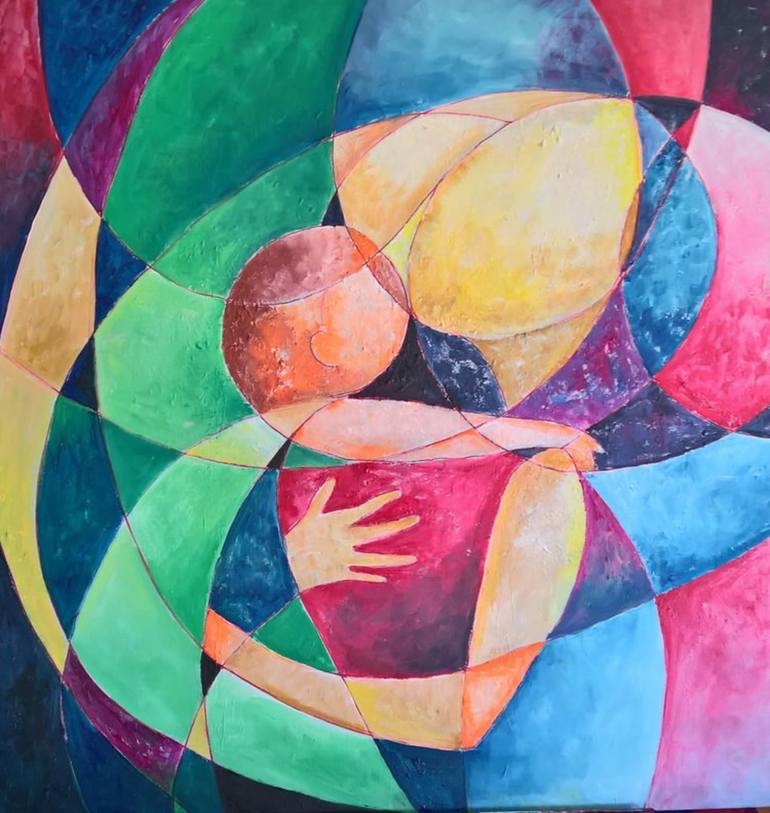
Very interesting article and beautiful painting
LikeLike